
Those times when you’re freaking out a bit, and things seems to turn out ok? Yeah, that’s nice.
RT @eightface: New post: Men…
RT @eightface: New post: Men as fashion hoarders – eightface.com/2012/01/men-as…
GReat Ways to Differentiate Helvetica from Arial, a print by
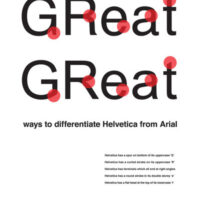
GReat Ways to Differentiate Helvetica from Arial, a print by George Drury.
Men as fashion hoarders
For Guys, a Great Find is Often Multiplied, a New York Times piece by John Ortved, examines a penchant among men for hoarding wardrobe items.
Women shop, men stockpile. That’s one theory, anyway, of how men buy clothes differently from women. If women see shopping as an opportunity, a social or even therapeutic activity, the thinking goes, then men see it as a necessary evil, a moment to restock the supply closet.
I hate shopping, this is starting to look like a pretty good idea.
Robot making a sandwich
A robot making a sandwich (and popcorn). Oh, you’re not impressed?
sudo make me a sandwich
RT @eightface: New post: Robot…
RT @eightface: New post: Robot Making a Sandwich eightface.com/2011/12/robot-making-a-sandwich/
Nothing like receiving an unsubscription…
Nothing like receiving an unsubscription notification email when you unsubscribe from a mailing list.
Ansari, Murphy and Chang in Tokyo
The Hangover Pt III chronicles Brett Martin’s journey through Tokyo with with Aziz Ansari, David Chang and James Murphy (from LCD Soundsystem). Crack a beer and take some time to follow the escapades of a true wolfpack.
We are not accustomed, here at GQ, to acting as a celebrity Make-A-Wish Foundation. But something about this tweet captured our attention. The grouping was unlikely, yet it made an instant kind of cosmic sense, as though you had been waiting for the picture long before it appeared. The Venn diagram of their fame might have a small overlap—I found that most people knew two of the three—but that intersection was a particular pocket of smart, inventive, forward-looking cool. The destination, too, made a certain intuitive sense, Tokyo being both a fun-house mirror of pop-culture iconography and a place where generations of Western seekers have gone to feel both reverently awed and gloriously disoriented.
It’s hard to argue quality…
It’s hard to argue quality over quantity when your last blog post was three weeks ago and concerned the physics of falling cats.
Cat physics

A diagram from the 1969 study, A Dynamical Explanation of the Falling Cat Phenomenon, by Kane and Scher of Stanford University. Apparently one of the very few scientific papers on cat physics.
Kane and Scher neither lifted nor dropped a single cat. Instead, they created a mathematical abstraction of a cat: two imaginary cylinder-like chunks, joined at a single point so the parts could (as with a feline spine) bend, but not twist. When they used a computer to plot the theoretical bendings of this theoretical falling chunky-cat, the motions resembled what they saw in old photographs of an actual falling cat. They conclude that their theory “explains the phenomenon under consideration”.
@zachinglis thanks dude, still a…
@zachinglis thanks dude, still a little bit early for canada though 😉
How Will Shortz edits a crossword
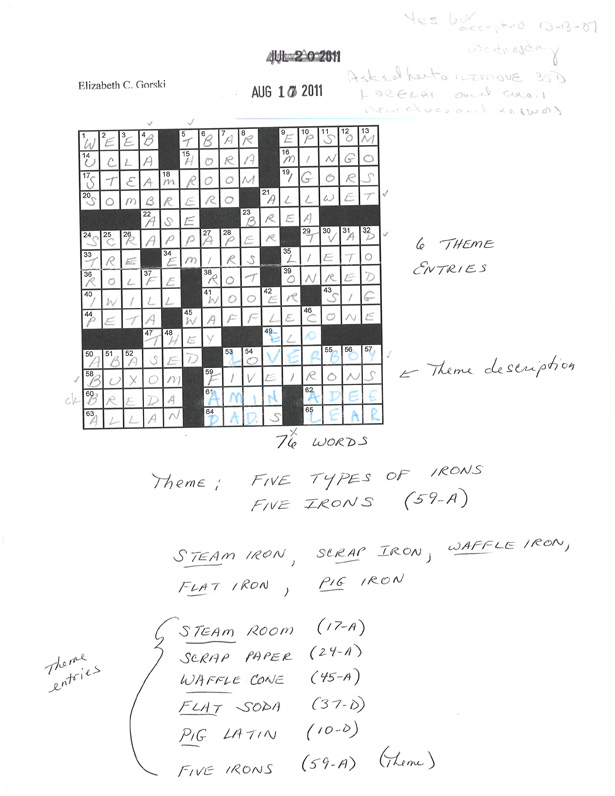
Will Shortz has been the New York Times crossword editor for almost twenty years. He explained to Alex Hoyt how he goes about editing the puzzles.
Every crossword in the Times is a collaboration between the puzzle-maker and the puzzle editor. On average, about half the clues are mine. I may edit as few as five or ten percent of the clues, or as many as 95 percent for someone who does a great puzzle but not great clues. Why accept a puzzle when I’m going to edit 95 percent of the clues? Well, if someone sends me a great puzzle with an excellent theme and construction, you want fresh, interesting, familiar vocabulary throughout the grid, I feel it would be a shame to reject it on account of the clues, because I can always change them myself.