
Fuck me. Now the flight has been pushed to 00:30 with arrival at 03:20 in Ottawa. That will be convenient.
Yea! Flight pushed back another…
Yea! Flight pushed back another hour, currently leaving at 2030 and due in to ottawa at 2320.
Through security, almost there. Just…
Through security, almost there. Just need to make it onto the plane and actually have it take off. Flight delayed again, was 12:05 now 19:30
The communications infrastructure at Heathrow…
The communications infrastructure at Heathrow reminds of of playing broken telephone when I was a kid.
Still standing at air canada…
Still standing at air canada checkin at heathrow, no word on AC889 yet.
My flight out AC889 may…
My flight out AC889 may get cancelled because they need a plane to land first.
Post workout and swim, sitting…
Post workout and swim, sitting at an over priced hotel restaurant to get some food.
At the Heathrow Hilton, fingers…
At the Heathrow Hilton, fingers crossed that my flight tomorrow makes it out. Think I’ll hit up gym/pool then time for some food.
Ugh, lots of snow in…
Ugh, lots of snow in the UK. Flight to Canada on Monday, hopefully there won’t be any issues. Don’t have my hopes up though.
Eco on Wikileaks
From Umberto Eco’s article about Wikileaks.
I once had occasion to observe that technology now advances crabwise, i.e. backwards. A century after the wireless telegraph revolutionised communications, the Internet has re-established a telegraph that runs on (telephone) wires. (Analog) video cassettes enabled film buffs to peruse a movie frame by frame, by fast-forwarding and rewinding to lay bare all the secrets of the editing process, but (digital) CDs now only allow us quantum leaps from one chapter to another. High-speed trains take us from Rome to Milan in three hours, but flying there, if you include transfers to and from the airports, takes three and a half hours. So it wouldn’t be extraordinary if politics and communications technologies were to revert to the horse-drawn carriage.
An interesting analogy. Political communications probably won’t slide back to horses, but sneakernets are looking good.
The first Christmas card
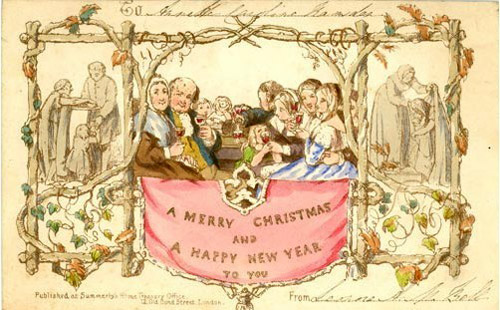
The world’s first commercial Christmas card was commissioned by Henry Cole in 1843. Three of the remaining cards were recently sold at auction, with one of them fetching over £8000. The cards originally came with an illustrated envelope.
These Christmas cards are interesting pieces of ephemera, but I have to admit that David Mitchell’s take on them is more in keeping with my opinions.
It’s natural to think of Sir Henry as an admirable fellow for having established this most respectable of Christmas customs. It’s natural but it’s a mistake. Bear in mind that, before printed Christmas cards existed, seasonal messages were written individually and in longhand. Before Sir Henry’s brain started to gestate, that was the tradition. His idea was to industrialise it.
He mechanised the exchange of greetings so that more greetings could be exchanged more quickly between more people. He considered the previous rate of greeting-exchange to be tediously slow and resolved to speed it up. This way, he presumably reasoned, people can show how much they care with much less effort. It’s carefree caring: now your heartfelt solicitude can reach dozens of people at once. The man must have thought he was actually manufacturing love.
RT @eightface: Eco on Wikileaks…
RT @eightface: Eco on Wikileaks http://8face.com/x/r