Skip under construction message
Under construction

Under Construction

Building in public 👉 github repo / changelog

Polymaths

From the The Last Days of the Polymath by Edward Carr:

The question is whether their loss has affected the course of human thought. Polymaths possess something that monomaths do not. Time and again, innovations come from a fresh eye or from another discipline. Most scientists devote their careers to solving the everyday problems in their specialism. Everyone knows what they are and it takes ingenuity and perseverance to crack them. But breakthroughs—the sort of idea that opens up whole sets of new problems—often come from other fields.

Perhaps we need a return to the Renaissance ideal.


Learn better with ugly fonts

Two studies, by Princeton psychologists, have found that using a hard-to-read font can lead to improved memory performance. They compared the retention of material set in Monotype Corsiva, Comic Sans Italicized and Haettenschweiler versus the same material set in Helvetica and Arial. From the research paper published in Cognition:

This study demonstrated that student retention of material across a wide range of subjects (science and humanities classes) and difficulty levels (regular, Honors and Advanced Placement) can be significantly improved in naturalistic settings by presenting reading material in a format that is slightly harder to read.

Fluency interventions are extremely cost-effective, and font manipulations could be easily integrated into new printed and electronic educational materials at no additional cost to teachers, school systems, or distributors. Moreover, fluency interventions do not require curriculum reform or interfere with teachers’ classroom management or teaching styles.

I doubt that textbooks are in any danger of being typeset in crappy typefaces, but there’s probably some room for typeface variation that could improve learning. This technique is probably more relevant for handouts and classroom materials provided by teachers.

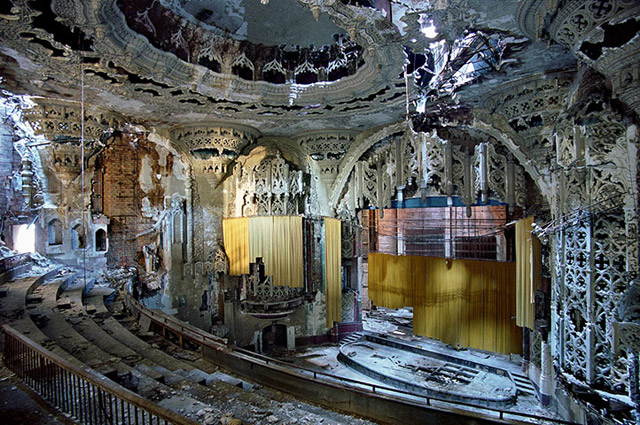


The ruins of Detroit

Ruined United Artists Theatre in Detroit

Yves Marchand and Romain Meffre photographed the the abandoned and decrepit structures of Detroit.

Having photographed old buildings – “mainly disused theatres” – in Paris, they happened upon an image of Michigan Central train station in Detroit while surfing the internet for pictures of abandoned buildings. “It was so stately and so dramatic that we decided right then we had to go,” says Meffre, “but we were naive; we had no idea of the scale of the project, of the vastness of downtown Detroit and its ruins. There is nothing comparable in Europe.”

Be sure to visit the gallery as well.


What was the hipster?

Mark Grief examines the the birth, evolution and future of the hipster.

It would be too limited, however, to understand the contemporary hipster as simply someone concerned with a priori knowledge as a means of social dominance. In larger manifestations, in private as well as on the street, contemporary hipsterism has been defined by an obsessive interest in the conflict between knowingness and naïveté, guilty self-awareness and absolved self-absorption.

The article is interesting and worth the read, but it’s the comments that make it gold — they’re like reading overwrought YouTube comments written by, well, hipsters.