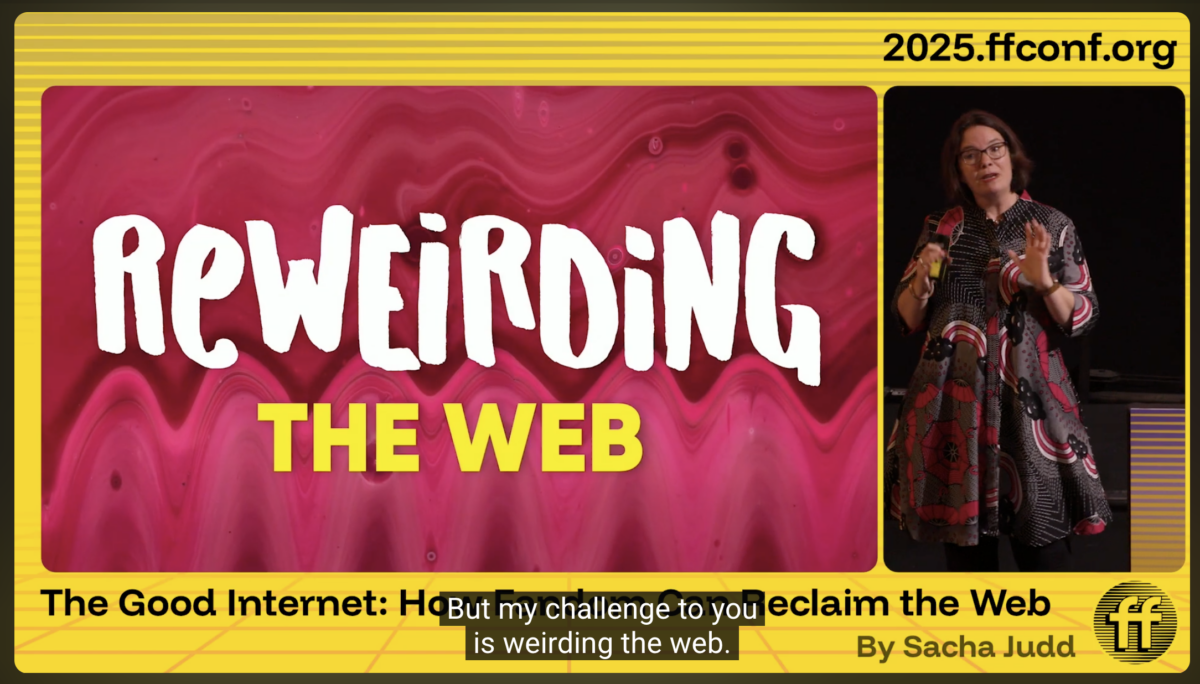
The Good Internet: How Fandom Can Reclaim the Web.
This talk by Sacha Judd at FFConf was stellar. I’m in the process of finding my back to the weird web.

Under Construction
I make things on the internet
The Good Internet: How Fandom Can Reclaim the Web.
This talk by Sacha Judd at FFConf was stellar. I’m in the process of finding my back to the weird web.
From Requiem For Early Blogging:
[I]f you wanted people to read your blog, you had to make it compelling enough that they would visit it, directly, because they wanted to. And if they wanted to respond to you, they had to do it on their own blog, and link back. […]
I think of this now as the difference between living in a house you built that requires some effort to visit and going into a town square where there are not particularly rigorous laws about whether or not someone can punch you in the face. Before social media, if someone wanted to engage with you, they had to come to your house and be civil before you’d give them the time of day or let them in.
This made me laugh, but it’s true.
I used to have comments enabled here back in the day, and often had interesting discussions with people. It became a lot to maintain though. I sort of regret completely nuking that database table at one point, mostly because I’d like to see some of those conversations again.
Have considered adding some sort of Bluesky, AT Proto or other indieweb commenting, but not really active enough anywhere at the moment to warrant it. Edit: Seems like I can just add an Autoblue comments block to the post and it will render replies, but might need to stick it directly in old templates.
Revisiting why hyperlinks are blue. For anyone interested in the history of hypertext, the web or precursors to it
As a follow-up to yesterday’s post, an NYT piece on the game’s origin, Wordle Is a Love Story
The word game has gone from dozens of players to hundreds of thousands in a few months. It was created by a software engineer in Brooklyn for his partner.
Also refreshing to read that it’s a fun personal project and not an exercise in growth hacking
I challenge you to think clearly about the many disparate networks you’re part of and think about the ideas you might want to offer those networks that you don’t want to get lost in the feed. Ideas you might want to return to.
Cure for the Common Webfont, Part 1: Alternatives to Arial (and Helvetica)
2010 is the Year of Webfonts. It seems a new webfont service is popping up every month, and many print typefaces are being reengineered for optimal rendering on multiple platforms and browsers. The days of relying on Arial, Georgia, Lucida, and Verdana are past. So now that a world of new options is opening up to web designers, let’s take at look alternatives to the old “web safes”, starting with the most common one of all.
A submission to 10k Apart by Tobie Langel
Helvetify for Safari.
Helvetify is an extension that basically sets the web page’s font to, yes, Helvetica (Neue to be exact.) With Safari 5, Helvetica on the web truly looks beautiful.
Nothing quite like being featured in a minimalist web design post in the midst of a half-assed live redesign. In any case, you might find some better inspiration there.
Antonio Carusone offers eight simple steps for improving your typography. It’s fairly standard for the most part, but he provides some good CSS examples for web developers.
The League of Moveable Type is an attempt to bring quality open-source typography to the web. It’s an honourable pursuit and will hopefully gain some traction, but I’m not really a big fan of the name.