Skip under construction message
Under construction

Under Construction

Building in public 👉 github repo / changelog


The 92 year old bootlegger

One of the world’s most prolific movie pirates is a pensioner from Brooklyn.

“Big Hy” — his handle among many loyal customers — would almost certainly be cast as Hollywood Enemy No. 1 but for a few details. He is actually Hyman Strachman, a 92-year-old, 5-foot-5 World War II veteran trying to stay busy after the death of his wife. And he has sent every one of his copied DVDs, almost 4,000 boxes of them to date, free to American soldiers in Iraq and Afghanistan.


Designers writing custom code

From Designing Programs by Casey Reas and Chandler McWilliams.

Writing software is something that’s not typically associated with the work of a visual designer, but there’s a growing number of designers who write custom software as a component of their work. Over the last decade, through personal experience, we’ve learned many of the benefits and pitfalls of writing code as a component of a visual arts practice, but our experience doesn’t cover the full spectrum. Custom software is changing typography, photography, and composition and is the foundation for new categories of design practice that includes design for networked media (web browsers, mobile phones, tablets) and interactive installations. Most importantly, designers writing software are pushing design thinking into new areas.

The asked a number of designers the impetus for writing their own software, and how it has impacted their work.

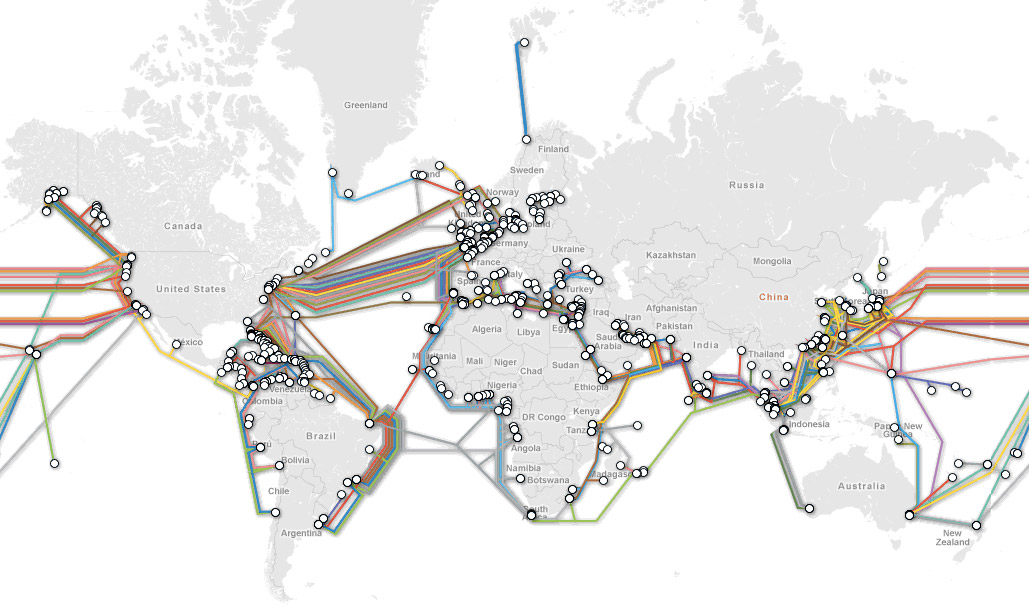
Submarine Cable Map

Submarine Cable Map

The Submarine Cable Map, just in case you wanted to know where your bits are going. Here’s an excerpt from the description of the site:

TeleGeography’s free interactive submarine cable map is based on our authoritative Global Bandwidth research, and depicts active and planned submarine cable systems and their landing stations. Selecting a cable route on the map provides access to data about the cable, including the cable’s name, ready-for-service (RFS) date, length, owners, website, and landing points. Selecting a landing point provides a list of all submarine cables landing at that station.

The source is available too.


The newsgroup post announcing the WorldWideWeb app

An excerpt from Tim Berners-Lee’s post to comp.sys.next.announce concerning the release of the WorldWideWeb app:

This project is experimental and of course comes without any warranty whatsoever. However, it could start a revolution in information access. We are currently using WWW for user support at CERN. We would be very interested in comments from anyone trying WWW, and especially those making other data available, as part of a truly world-wide web.

A revolution in information access indeed.

You also might be interested in this post from the eightface archive: The oldest page on the internet.


Psilocybin makes the brain work less

Researchers at Imperial College London have been exploring the effects of psilocybin on the brain. A quote from professor David Nutt:

Psychedelics are thought of as ‘mind-expanding’ drugs so it has commonly been assumed that they work by increasing brain activity, but surprisingly, we found that psilocybin actually caused activity to decrease in areas that have the densest connections with other areas. These hubs constrain our experience of the world and keep it orderly. We now know that deactivating these regions leads to a state in which the world is experienced as strange.

Here are links to abstracts from the first and second study.


The Deleted City

The Deleted City

The Deleted City is a digital archaeology of the world wide web as it exploded into the 21st century. At that time the web was often described as an enormous digital library that you could visit or contribute to by building a homepage. The early citizens of the net (or netizens) took their netizenship serious, and built homepages about themselves and subjects they were experts in. These pioneers found their brave new world atGeocities, a free webhosting provider that was modelled after a city and where you could get a free “piece of land” to build your digital home in a certain neighbourhood based on the subject of your homepage. Heartland was – as a neigbourhood for all things rural – by far the largest, but there were neighbourhoods for fashion, arts and far east related topics to name just a few.


Ansari, Murphy and Chang in Tokyo

The Hangover Pt III chronicles Brett Martin’s journey through Tokyo with with Aziz Ansari, David Chang and James Murphy (from LCD Soundsystem). Crack a beer and take some time to follow the escapades of a true wolfpack.

We are not accustomed, here at GQ, to acting as a celebrity Make-A-Wish Foundation. But something about this tweet captured our attention. The grouping was unlikely, yet it made an instant kind of cosmic sense, as though you had been waiting for the picture long before it appeared. The Venn diagram of their fame might have a small overlap—I found that most people knew two of the three—but that intersection was a particular pocket of smart, inventive, forward-looking cool. The destination, too, made a certain intuitive sense, Tokyo being both a fun-house mirror of pop-culture iconography and a place where generations of Western seekers have gone to feel both reverently awed and gloriously disoriented.